
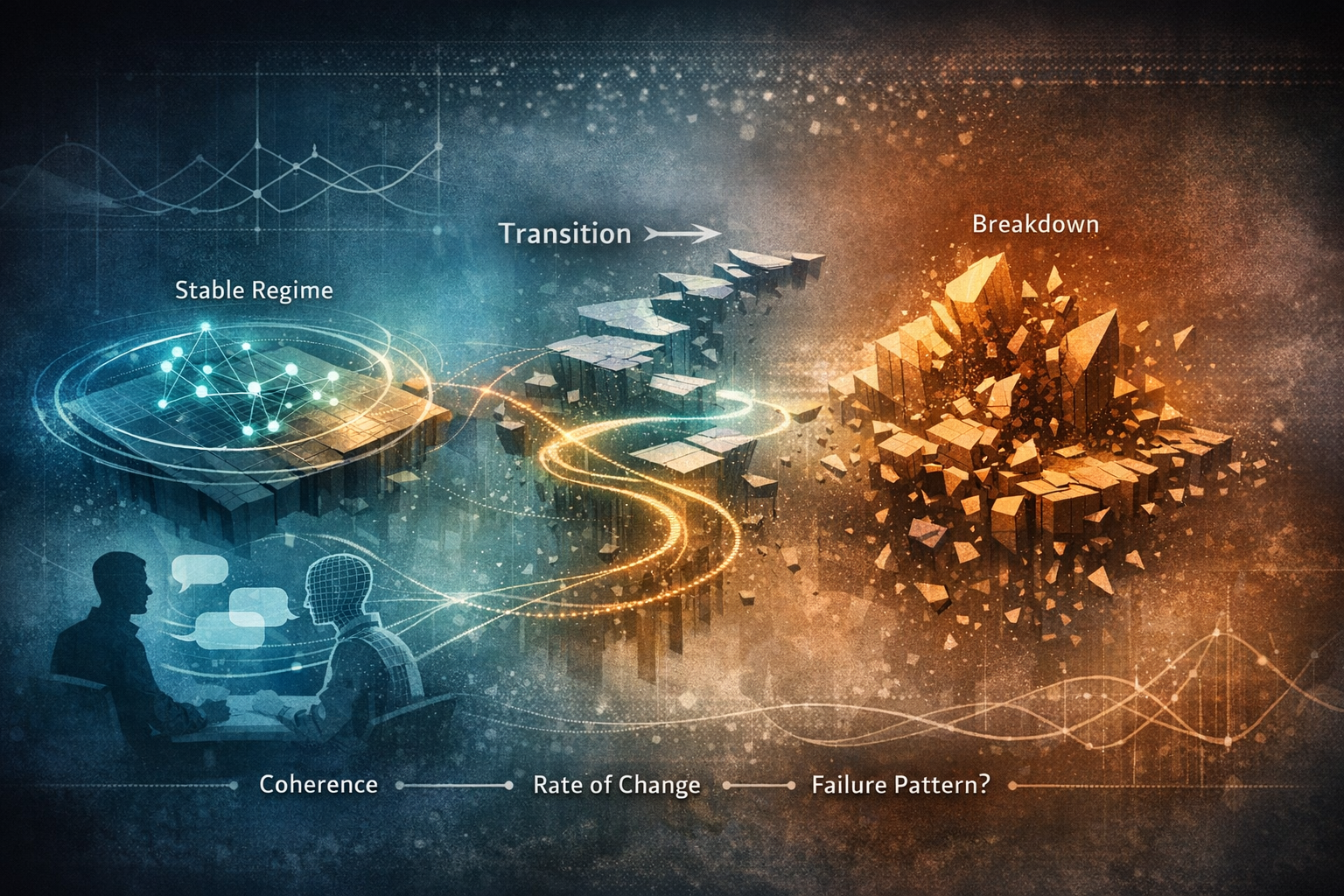
A recent paper by Hudson and Hudson introduces a hypothesis worth taking seriously. Their Signature-Induced Behavioral Regime (SIBR) framework proposes that recurring patterns in how someone interacts with a language model—reasoning structure, abstraction, vocabulary, conversational pacing and other features—can act as a kind of interaction signature. The model responds not only to the latest prompt, but to patterns that have accumulated across the conversation.
The interesting part is that this doesn't require persistent memory.
The model doesn't have to recognize a particular person. It only has to encounter a sufficiently similar pattern. If that pattern influences which kinds of responses become more likely, then a similar interaction signature in a newly initialized session could produce a similar behavioral regime without the model remembering the earlier conversation at all.
That shifts the object we're looking at.
Most discussions of prompting focus on individual inputs: change the instructions and observe what happens to the output. SIBR asks us to look at the interaction across time instead. A prompt still matters, but it arrives inside a conversation whose previous turns have already changed the context in which the next prompt will be interpreted.
The paper calls the recurring pattern an interaction signature and the relatively stable response pattern it produces a behavioral regime. In simplified form, the proposed sequence is:
interaction signature → regime activation → relatively stable response behavior.
That gives us a useful way to describe something people who work with language models for long periods sometimes notice. A conversation can develop a recognizable way of moving. Explanations begin arriving at a similar level of abstraction. Certain distinctions remain available across turns. The model appears to anticipate the kind of reasoning the interaction has been rewarding, even when the latest prompt doesn't explicitly request it.
None of that requires us to say the model knows who it's talking to. The current conversation may provide enough information to reproduce much of the effect.
SIBR gives us a possible explanation for how that pattern becomes active. What interests me is what happens next.
Once a regime has formed, what keeps it there?
Some interactions seem to establish a recognizable pattern almost immediately, while others take much longer. Some become more coherent as the conversation continues. Others gradually lose distinctions that seemed stable twenty turns earlier, even though the surface style of the interaction hasn't changed very much.
If those differences are real, signature consistency may be only part of the story.
The paper associates stronger and more consistent interaction signatures with more stable regimes, which gives us somewhere to begin. It also creates another question. What makes a signature strong in practice?
Simple repetition probably isn't enough. A person could repeatedly use the same vocabulary, sentence structure and explicit instructions while changing the distinctions that actually matter to the conversation. Another interaction might vary considerably at the surface while repeatedly preserving the same way of testing claims, handling uncertainty or revising conclusions.
Those two conversations could look very different if we measured only their visible regularities.
This makes me wonder whether part of what matters is not merely repetition, but continuity across change.
Suppose a conversation establishes a distinction early and continues using it. Later examples test that distinction rather than merely repeating it. Sometimes the distinction survives. Sometimes the new example exposes a weakness and the conversation modifies it. The wording may drift considerably while something about the reasoning remains recognizable.
Now compare that with an interaction that preserves the vocabulary while gradually changing what the vocabulary means. Surfac