
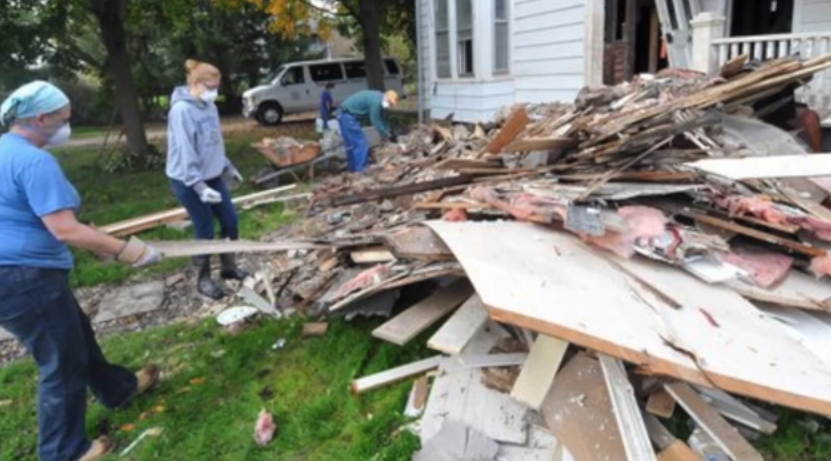
SCHOHARIE — This August 28th marks fifteen years since Hurricane Irene brought disastrous flooding to Schoharie communities. For those of us who lived through the catastrophe, the devastation wrought by Irene can be difficult to convey to anyone without the shared experience. The flood's impact was so severe that Schoharie's relief efforts received national attention, including from late-night legend Dave Letterman, who had developed a special place in his heart for the village. It also received the attention of a group of high schoolers from Red Hook, who came to document Schoharie's relief efforts roughly two months after the flood. As a part of their broadcast journalism course, the students made a documentary called Irene's Survivors: The Schoharie Story.
The students were encouraged by Red Hook High School teacher Tara Miller, who had grown up in the area, to document the situation. Despite some images of Schoharie County at large (including Middleburgh), the documentary's primary focus is on the Village of Schoharie itself. Students interviewed former Mayor John Borst via Skype, who gave them an overview of the situation, reporting that "80% of the homes and 100% of the businesses" had been hit. Borst indicated his home had not been impacted by the flood, and learned that one could not truly "understand" what it was like unless they had lived through it, and that he'd developed more compassion for the community as a result, noting that neighbors who had previously not been speaking to one another set aside differences to help in clean efforts.
As the interviewers were high school students, it may not come as a surprise that some of the more insightful interviews in the documentary come from Schoharie High School students. SCS seniors Katie Farineau and Lacy Slater recount their experiences with the flood, extolling the virtues of the small town they grew up in and how those same virtues became an outpouring of support and assistance after the flooding. "The way we came together after this was amazing," said Slater. Farineau recounts the story of a neighbor wading through "five feet of mud" to locate her favorite Christmas ornament that had been in her family's recently built shed that had ended up "a mile downstream." "How do you thank someone for doing that? It's amazing," wondered Farineau.
Flash forward five years, and it seems the outpouring of generosity Farineau experienced had not been lost on her. Farineau left for Harvard after graduating from Schoharie, joined the Harvard Humanitarian Initiative (HHI), and played keyboards in The Big 6, a group of "disaster-relief experts with a passion for rock'n' roll" who played benefit concerts for hurricane victims. "As someone who was on the receiving end of aid, you know how important it is that people pay attention to you and people remember what your community has gone through long after the press has left," Farineau told the Harvard Gazette in 2017. "It was a really significant event in my life and led to me working at HHI now," she said. "I was once someone on the ground in that situation…it's important to be there, to be listening to folks in need, and give something back."
Social worker Kathleen Keese had come to help because she had been worried about her friends and family who lived in the village and noted the difference between seeing the damage on television and witnessing it in person. "Unless you were here, you had no idea what you were going to find," said Keese, who accompanied her loved ones as they saw their homes for the first time after returning.
The film also recounts the confusion around the Gilboa Dam's sirens going off and the chaos of evacuation at the sound of the siren, which had been activated by Sheriff Tony Desmond in coordination with the dispatchers and Emergency Management Office in response to a loss of communication with the dam's sensors and detection systems. It's easy to forget there had been an earthquake just eleven days earli