
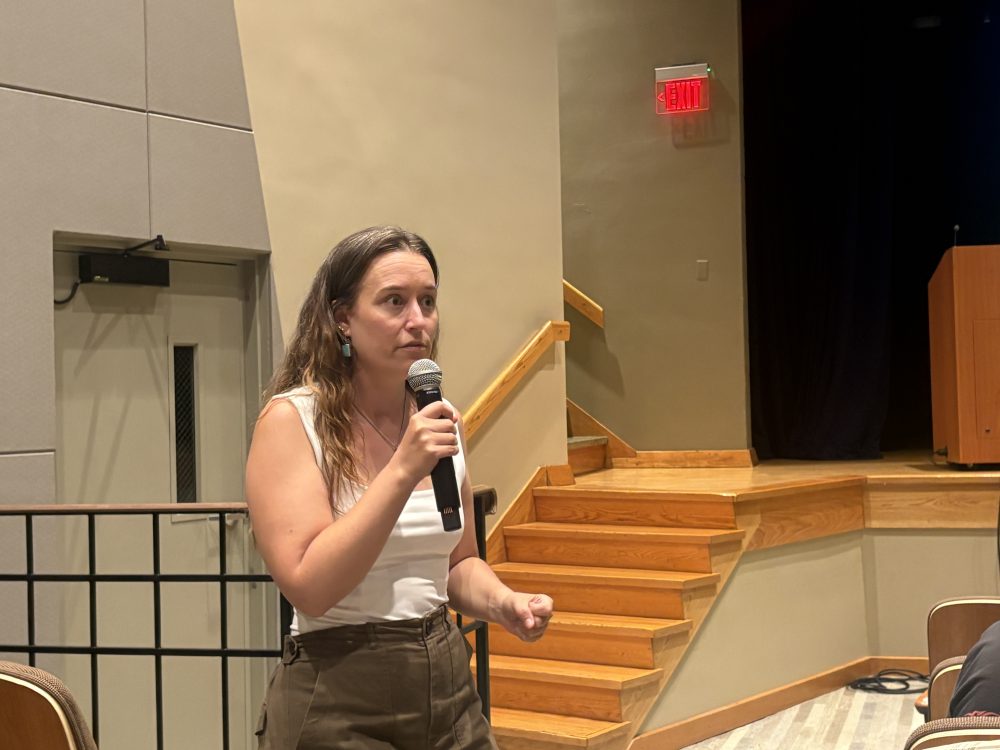
Tanja Konwinski speaks during an Aug. 18 program at SUNY Cobleskill organized by groups opposing the Constitution Pipeline.
COBLESKILL — Advocacy groups opposed to the proposed Constitution Pipeline made their case during a Tuesday, Aug. 18 program in Bouck Hall at SUNY Cobleskill.
Addressing a crowd of about 100, speakers from Stop The Con, the Environmental Health Project and the Waterfall Unity Alliance presented a long list of what they feel will be potential harmful effects of the pipeline, including air and water pollution, and the possibility of explosions and fires.
Tanja Konwinski, a resident of Warnerville in the Town of Richmondville, spoke extensively at the Aug. 18 event while also introducing other speakers and guiding the program along. She said the pipeline, if built, would run through her property by virtue of an easement granted before she bought the land, an easement that runs with the property.
Konwinski, who is involved with the Waterfall Unity Alliance, went through a history of the natural gas pipeline, a project of a company called Williams.
First proposed in 2012, the Constitution Pipeline was approved by the Federal Energy Regulatory Commission in 2014 but ran into a stumbling block in 2016 when the New York State Department of Environmental Conservation ruled that Williams did not provide adequate information on compliance with the Clean Water Act.
The project was abandoned in 2020 but has been revived by Williams since President Trump took office for his second term in 2025. According to speakers at the Aug. 18 event, FERC is expected to approve the project again and that the decision could come fairly soon.
While Williams representatives have made comments indicating the NYS DEC has no say this time around for procedural reasons, speakers at the Aug. 18 SUNY Cobleskill event said that is not necessarily the case.
"Many people have spent years of their lives fighting to stop this pipeline," Konwinski said. "It's been years and years of hard, diligent work. It's pretty upsetting we're back here again."
The Constitution Pipeline would be a 30-inch diameter natural gas line starting in Susquehanna County in Northeast Pennsylvania and then running 124 miles through Broome, Chenango, Delaware and Schoharie Counties in New York. It would end by connecting into the existing compressor station in Wright, Schoharie County and contributing natural gas to the Tennessee and Iroquois pipelines.
The Wright compressor station would be greatly expanded to accommodate the Constitution Pipeline, speakers at the SUNY Cobleskill program said.
According to information presented at the Aug. 18 program, construction and installation of the pipeline would destroy about 700,000 trees, impact 95 acres of wetlands, clear 1,872 acres of land and cross 330 bodies of water.
"These impacts should not be understated," Konwinski said.
Environmental Health Project Field Manager Talor Musil and EHP Northeast Project Coordinator Sarra Bridges spoke about possible air pollution along the pipeline and at the compressor station and the resulting potential negative health impacts.
Konwinski added that the pipeline crossing so many streams and other bodies of water would have harmful effects on brook trout and other species. Placing the pipeline across the Schoharie Creek with its potential for flooding would be a "disaster waiting to happen," she said.
"Our greatest resource, our clean and abundant water, would possibly be lost," Konwinski continued.
Attorney Anne Marie Garti, who has been working Pro Bono on legal efforts to stop the Constitution Pipeline, said the key now is reauthorizing the NYS DEC to again deny the water quality certification.
"We need all of you in this room to get involved," she said. "We need to build that opposition."
West Fulton resident Bethany Yarrow, co-founder of the Waterfall Unity Alliance, said the group will soon (Sept. 19-Oct. 4) hold a two-week, 113-mile walk along the route of the pi