
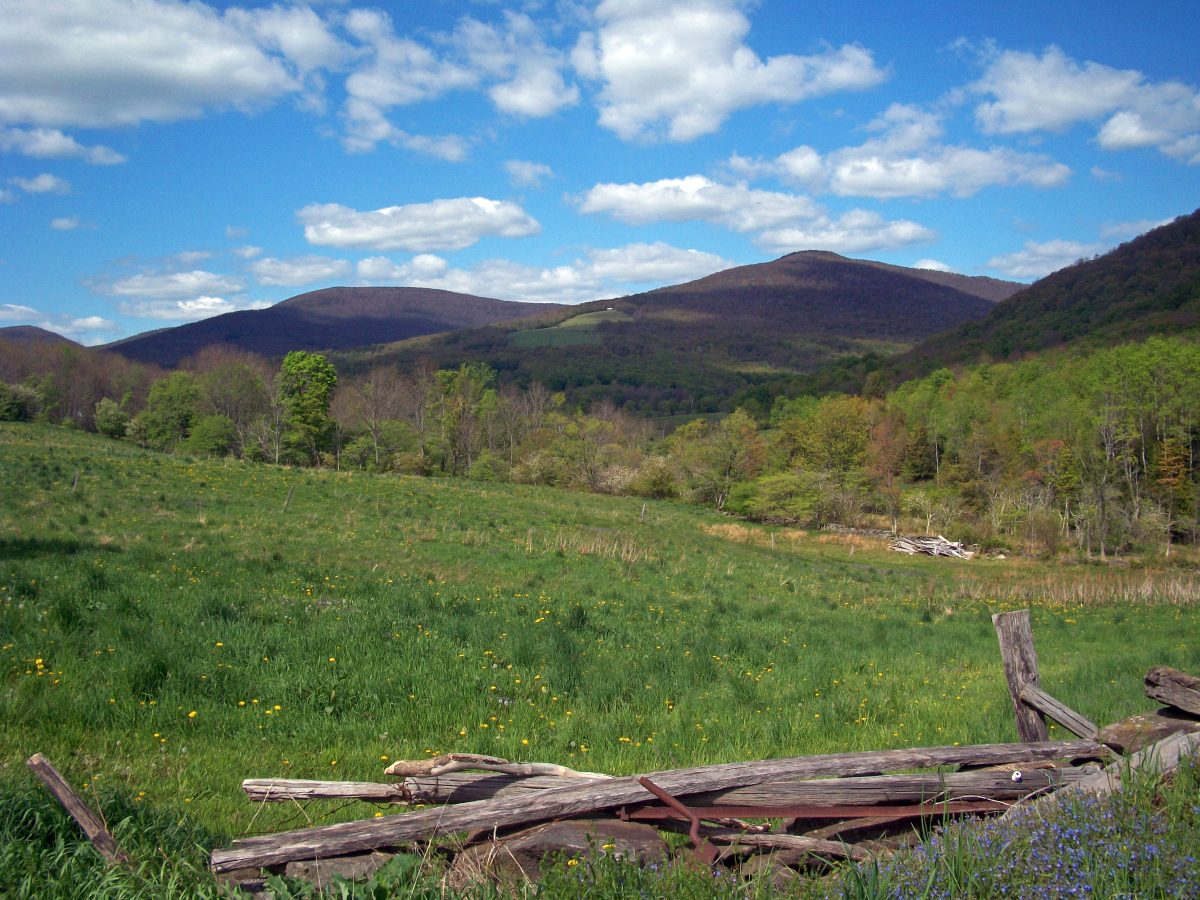
HALCOTT — Nestled deep in the Catskill Mountains, the Town of Halcott stands as one of Greene County’s most distinctive communities—a quiet valley ringed by peaks that has preserved its rural character for generations. With a population of 249 according to the 2020 U.S. Census (down slightly from 258 in 2010), Halcott remains a place of isolation by design, where the pace is slow, the views timeless, and the connection to the land runs deep.
Locals pronounce it “Hawk-it.” Visitors tend to say “Hal-cot.” Longtime resident Margaret “Peggy” DiBenedetto says the pronunciation is one quick way to tell who’s from here.
A biologist who earned her degree in Texas—the only time she lived away from Halcott—Peggy returned and now works for the New York Department of Environmental Conservation in land management. “This is wonderful,” she says. “I get paid to hike, and Greene County is my favorite place in the world, especially for hiking.” Through an ecological lens she observes the land and vegetation of our local valley. She is also the author of two books: “Silver Dollar Girls”, about a young woman who flees New York City during the coronavirus pandemic to her family’s Catskills farmhouse and discovers her great-grandmother’s secret diary as a World War II pilot, as well as her children’s book “Ebony Bear: A Nurturing Ursine Learns a Lesson”, in which a mother black bear teaches her three cubs to navigate the wilds.
The earliest settlement date documented in 19th-century county history is 1809, when Helmus Chrysler cleared land and built a house in the valley. In 1813, John P. Van Volkenburgh, his brother Peter, and their mother crossed Vly Mountain and moved into the dwelling Chrysler had built, marking what the historical account identifies as the beginning of Halcott's first permanent settlement. Earlier attempts to settle the area, dating to around 1790, had apparently been temporary. The area had long been a Munsee Lenape and Esopus tribe hunting ground. Historical accounts from the late 19th century identify a character named Froman as the last Native American resident of the valley. He lived near a spring where the Halcott Center road crosses the Delaware County line, fishing the clear streams and hunting until the encroaching farms and the “rattling of the white man’s implements of agriculture” drove the deer away. One morning, the stories say, he “followed his shadow” and was gone. There is no marked grave recorded in the county histories; local retellings sometimes place him just outside the town line.
Originally part of a larger settlement connected with Lexington beyond Hunter, Halcott broke away in 1851 and took its name from Greene County Sheriff George Washington Halcott. The state legislature formally recognized the new town the following year, in 1852 and the first town meeting was held on April 6, 1852 at the dawn of Halcott.
What makes Halcott unusual even by mountain standards is its geography. It is part of Greene County yet cut off by the Catskill ridges from the rest of the county by paved road. “It’s unusual that residents have to drive all the way around the mountains for an hour in order to reach their County seat in Catskill,” Peggy observes. Shirts sold in town capture the spirit of the place: the front reads “You can’t get here from there,” and the back says “You can’t get there from here.”
For generations those mountain crossings were possible, if difficult. An 1867 Beers atlas map shows five roads leading toward Vly Road (now associated with Bouton Road), the early center of the settlement. Former Halcott Town historian Audrey Johnson noted in a 1972 report that the road network dated back to the 1820s. Local historical research published in “The Times of Halcott” by Pattie Kelder (2021–2022), drawing on maps, photographs, oral histories, and earlier accounts, reconstructs the principal routes:
Turk Hollow Road was the "dance road." It climbed up into Lexington and on toward Westkill. Longtime resi