
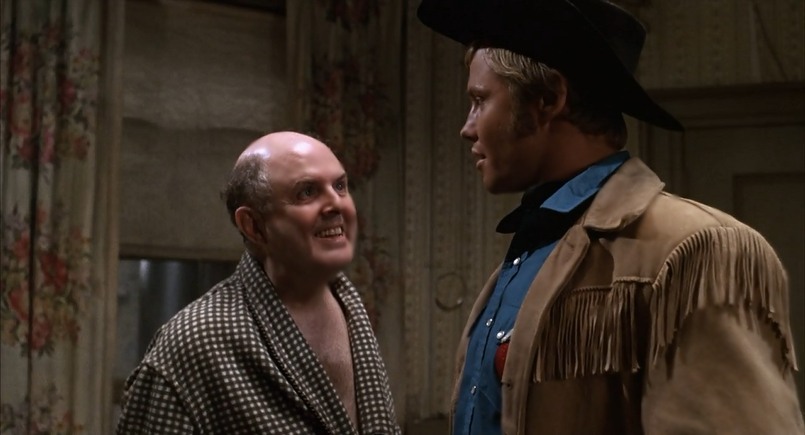
There is a local legend that when the famed character and West Fulton resident John McGiver read the script for 1969's Midnight Cowboy, he tossed it in the trash, apparently uninterested in the opportunity to play Mr. O'Daniel. According to the story, when his wife asked him what it was, he dismissed it as something he didn't want to do. She lifted it from the garbage and reminded him he had mouths to feed, so he'd better take the job. The anecdote of McGiver's reaction to the script for Midnight Cowboy is likely untrue (more on that later). Still, it is conceivable that the seasoned actor, whose career began in earnest in the mid-1950s within a well-oiled studio system working under the strict censorship guidelines of the Hays Code and the threat of McCarthyism, would not have understood how the script that just crossed his desk could have the possibility of success. But by the late 1960s, the Hollywood McGiver knew had become confused and out of touch with the counterculture; the Hays Code was gone, and McCarthy's influence had thankfully come to an end. McGiver, like many others involved, would be forgiven for not yet understanding the New Hollywood.
When British director John Schlesinger brought the idea of adapting James Leo Herlihy's 1965 novel to United Artists and producer Jerome Hellman, it could not have been made. The Hays Code was still in place (although dying a slow death), and as film historian and journalist Mark Harris points out in his essay about Midnight Cowboy, an argument was ongoing at Warner Bros. about exactly what the acceptable number of times "goddamn" could be used in Who's Afraid of Virginia Wolf? — hardly a welcoming environment for a film about down-and-out hustlers and male sex workers on the fringes of New York City. But things were on the cusp of change, and to his credit, Schlesinger, a rare-for-the-time openly gay filmmaker, on the heels of an Oscar nomination for 1965's Darling, gambled that the writing was on the wall, and along with Hellman, committed to bringing Midnight Cowboy to life.
The radical shift that occurred in the late 1960s in Hollywood is a well-documented phenomenon (for a deeper dive, Easy Riders, Raging Bulls: How the Sex-Drugs-and-Rock 'N' Roll Generation Saved Hollywood and Pictures at a Revolution: Five Movies and the Birth of the New Hollywood are revered explorations of the subject). In a nutshell, Hollywood studio heads were out of touch and confused by the counter-culture. Like many of their generation, they could not understand the youth of the 1960s, which meant they could not sell to this new audience. Easy Rider, an independently produced film that was a success without traditional studio backing (Columbia Pictures distributed the film but had no role or say in its creation), did its part to briefly upend the entire business model—the studios now needed the artists more than the artists needed the studios. The implication was that if studios wanted a hit (wanted their money), they would have to loosen the reins and allow a new generation of filmmakers, writers, and actors to run wild. The world had cracked open, and the studios' walls were not strong enough to withstand the tectonic shifts of the late 1960s.
Schlesinger hired the wonderfully named Waldo Salt to create a screenplay for Midnight Cowboy while he worked on another film (1967's Far from the Madding Crowd). Salt had been blacklisted in 1951 for refusing to testify before McCarthy and the House Committee on Un-American Activities and, like many other screenwriters, had struggled to find work ever since. By 1968, the Hays Code was officially gone, and that Spring, filming for Midnight Cowboy began. Their gamble had paid off, and the door was open for Schlesinger's film. (Salt would go on to win an Academy Award for Midnight Cowboy. Take that, McCarthy.)
The Motion Picture Association of America (MPAA) replaced the Hays Code with an internal rating system in 1968, a self-regulatory effort designed