
STAMFORD — Every Main Street has a story, but for most it is a story without end.
You only have to look to Hudson River School artist, Thomas Cole’s series of paintings, “Course of Empire” to see the pattern: The Savage State; The Arcadian or Pastoral State; The Consummation of Empire; Destruction; and Desolation. Or, as several keynote speakers at MARK’s recent two-day Main Street Summit described it from a different point of view: decline, intervention, growth, and maintenance.
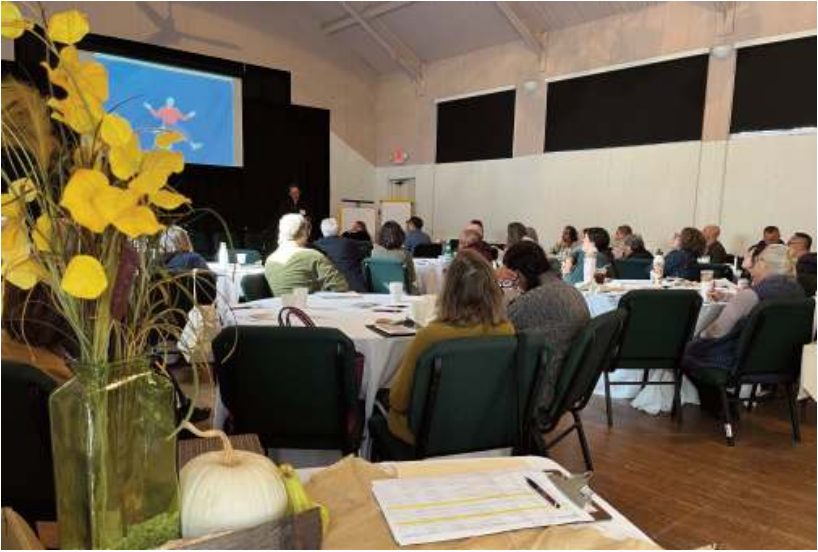
Over 70 participants from a dozen or more Catskill towns and villages attended the MARK Summit, the first of its kind for the region, to hear from 16 leading authorities in the fields of preservation, sustainability and the future of rural communities.
The Summit was organized by The MARK Project. Key concepts like “preservation is also economic development,” “there is no single solution for revitalizing a Main Street,” “sustainability means more than energy efficiency,” “preservation is an important part of the future,” and “for rural communities,” and “for rural communities, this work is particularly important,” were explored in a series of talks given by representatives of InSite Architecture, Spillian, the 7Group, Trampoline Design, NYS Homes and Community Renewal, NY State Department of State, NY State Empire Development Corp. and Preservation League of NY State. And that was just on Day One!
Day Two was more nuts-and-bolts, including talks on “climate responsive strategies for historic buildings,” “small business and shop local: measuring the impacts,” “saving the buildings that define our Main Streets,” wall insulation retrofits, and “Farm to Main Street: making the connection.”
The first day of the Summit took place at the Roxbury Arts Center and moved to the Margaretville Community Center on Day Two. Both Roxbury and Margaretville have been the beneficiaries of downtown revitalization programs due to the efforts of Peg Ellsworth, Executive Director of the MARK Project, who, over the last decade and a half, has spearheaded over fifty million dollars in downtown revitalization programs across the Central Catskills, and her talented and tirelessly supportive staff, including Sally Harkin, Director of Operations; Jonathan E. Andrews, Program Administrator; Alice Haroldson, Program Administrator; Fred Beemer, Housing Rehabilitation Specialist; and Luke Beemer, Housing Development Coordinator and Bookkeeper.
At the heart of the professional gathering were the experienced voices of Rick Hauser, Leigh Melander, and John Boecker. Rick Hauser is the creator of an “anti-blight tool” called “Main Street LLC” that advocates “putting your money where your house is.” He is also the long-time mayor of Perry, NY and used his hometown as an engaging case study for employing a three-part, phased revitalization strategy for Main Street Revitalization.
Leigh Melander is a mythologist, writer and cultural strategist whose work explores “how imagination shapes human possibility.” She holds a doctorate in cultural mythology and psychology, and a background in the arts. Melander is the co-founder of Spillian, a “regenerative center” for imagination and creativity in Fleishmanns, NY, She is also a storyteller, and her work examines how stories shape people, communities, and culture. Posing key questions on everyone’s mind, Melander asked the group, “What is it that we are choosing to preserve?” “What is being inherited? What is being passed on?” she added.
The answers Melander elicited were near and far afield.
“Is there something worth preserving?”
“How is the next generation going to get to fund what comes after us?”
“We’re hanging on by the skin of our teeth.”
“The responsibility has become greater than it was before.”
“Young people need to have a voice.”
“They aren’t making room for us. We need to be at the table”
“How do we move forward?”
Keynote speaker John Boeker had an answer to some of those questions. Boeker is an architect and co-founder of