
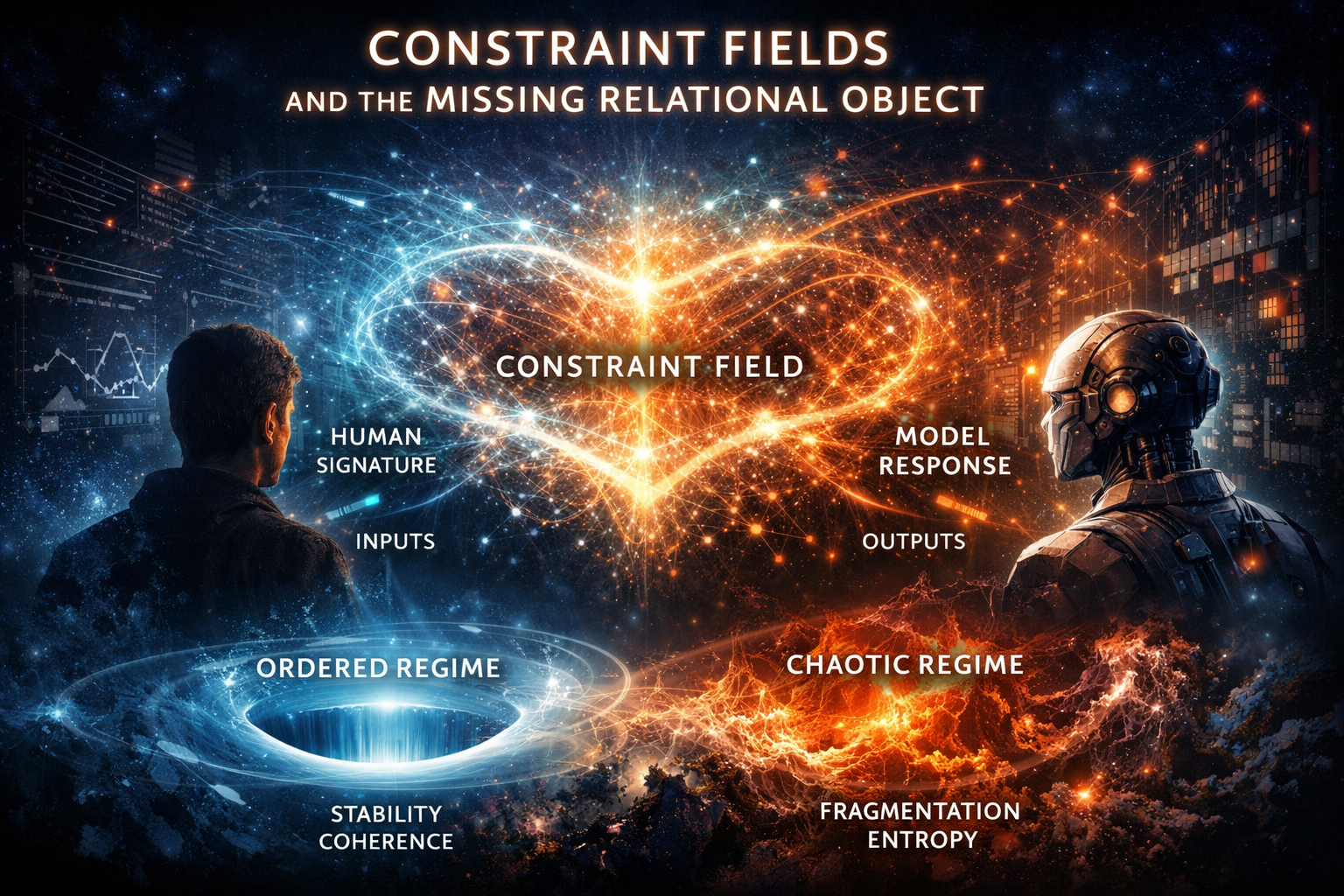
Justin and Chase Hudson have advanced the SIBR framework significantly in their new paper, Longitudinal Human–AI Interaction: From Interaction Signatures to Regime Dynamics. Their earlier work proposed that recurring patterns in human interaction can activate relatively stable behavioral regimes in language models. The new paper goes further by describing those regimes as attractor-like regions in the model's conditional output space, with early interaction helping establish where the model begins and subsequent constraints influencing how it moves from there.
The distinction between initial positioning and constrained traversal is especially useful.
It separates two things that can otherwise look like one phenomenon. Early turns may establish boundary conditions that make some later responses more likely than others, while the continuing interaction can reinforce, modify or eventually disrupt that trajectory. Continuity across a conversation therefore doesn't require us to imagine that the model has acquired a persistent identity or remembered a particular person. The interaction itself keeps supplying information that constrains what happens next.
That gives SIBR a much clearer mechanism than a simple claim that models “adapt to users.” It also produces questions we can test. Change the early interaction while preserving later prompts. Preserve the early interaction and introduce a contradictory pattern later. Change surface vocabulary while maintaining the same reasoning structure. Reproduce part of the interaction in a fresh session and see what returns.
If the framework is right, those disturbances shouldn't all produce equivalent results.
I think the paper also brings another question into view, although I'd be more cautious than I once was about naming the answer.
SIBR gives us a language for describing the human interaction signature and the behavioral regime that appears in the model. Between those two is the interaction itself: a continuing sequence in which each response becomes part of the context for whatever happens next.
It is tempting to call that a constraint field.
I've used language like that before because it captures something intuitively important. The model isn't responding to an isolated person or an isolated prompt. It is responding inside a context produced through repeated exchange, and neither participant alone determines the next state of that context.
The danger is that once we give this relationship a noun, it's very easy to start treating the noun as an independently existing mechanism.
We don't know that yet.
What we can observe is that superficially similar interactions don't always produce the same regime. A person's vocabulary, pacing or explicit instructions may remain fairly consistent while the interaction gradually loses distinctions that were previously stable. Conversely, the surface form can change considerably while something about the reasoning remains recognizable.
If those observations hold under controlled testing, then “signature consistency” may itself need to be unpacked.
What exactly is being kept consistent?
It could be vocabulary. It could be abstraction level, turn structure, recurring distinctions, correction patterns, expectations established by previous responses, or some combination of these. It could also be that different features matter at different points in the interaction.
That gives us a way to investigate the thing I've been calling the constraint field without assuming in advance that a field exists.
Disturb the components independently.
Keep the vocabulary and change the reasoning pattern. Keep the reasoning pattern and change the vocabulary. Preserve both but introduce a contradiction that forces revision. Reproduce the interaction with another model. Reproduce it with another person attempting to imitate the original interaction signature.
Then watch what survives.
Suppose two people can produce nearly identical surface signatures with th