
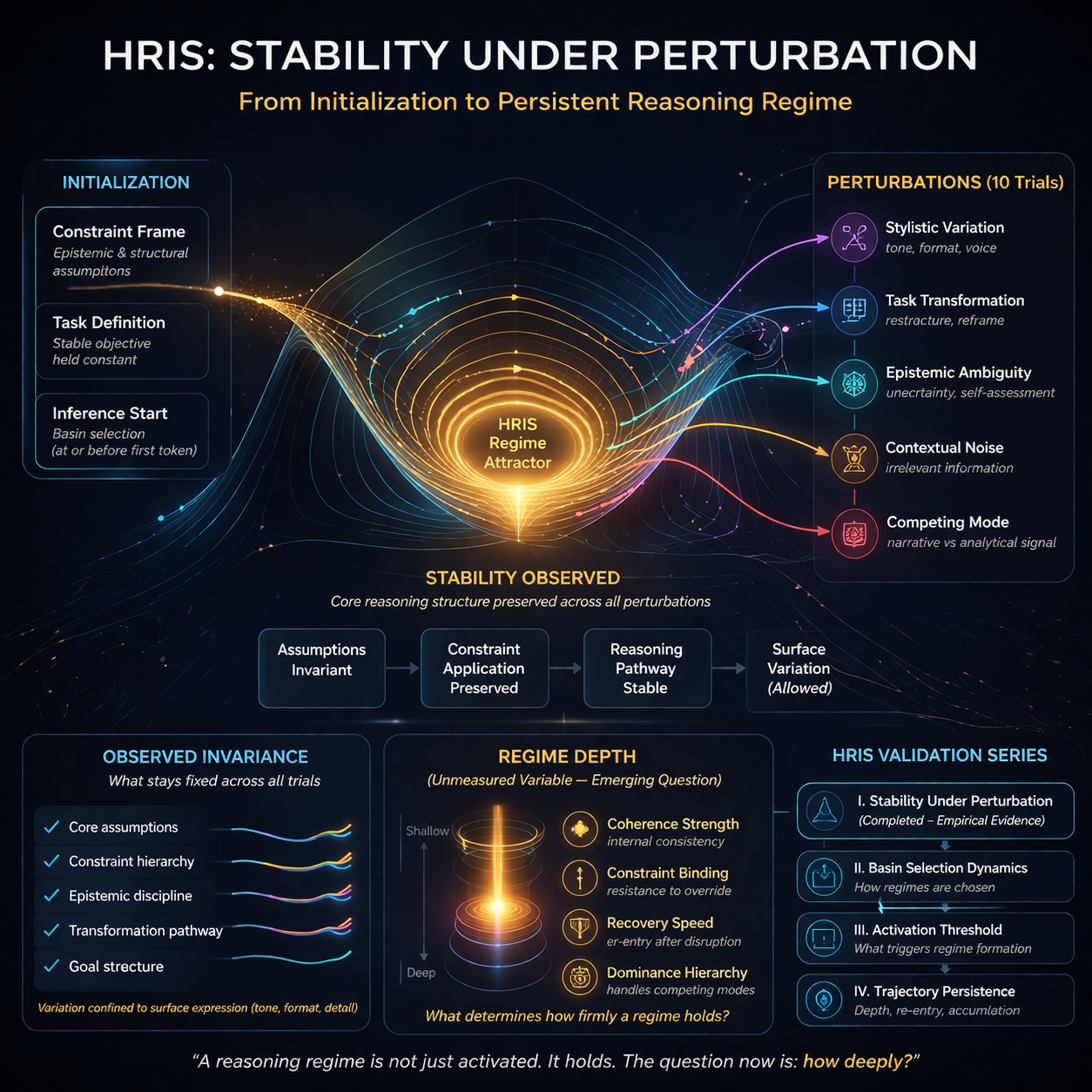
Justin and Chase Hudson have done something the HRIS framework needed: they've run the experiment.
In HRIS Validation I: Stability Under Perturbation, they present a reproducible ten-trial protocol designed to test whether an induced reasoning regime persists when the interaction is deliberately disturbed. The perturbations include stylistic changes, task transformation, epistemic ambiguity, contextual noise and pressure toward a competing mode.
Across the reported trials, the core reasoning structure remained recognizable while its surface expression changed.
The regime held.
That matters because persistence under disturbance tells us more than persistence under repetition. If I keep interacting with a model in roughly the same way and continue receiving roughly the same kind of response, several explanations remain available. Perhaps a regime has stabilized. Perhaps I'm simply continuing to provide the cues that reproduce it.
Perturbation gives the hypothesis somewhere to be wrong.
The competing-mode trials are particularly interesting. When the system was instructed to prioritize narrative or creative expression, the previously induced regime wasn't simply displaced. Instead, the new instruction was incorporated while the earlier reasoning structure remained visible.
The Hudsons describe this as hierarchical constraint organization. That seems like a useful description of the observed behavior: one set of constraints can apparently remain influential while another changes how the resulting behavior is expressed.
It also creates the next experiment.
If a regime can resist perturbation, how much perturbation can it resist?
The current study establishes persistence across the perturbations it tested. It doesn't yet tell us whether all stable regimes resist those perturbations equally, whether different kinds of disturbance matter differently, or whether there is some point at which the structure begins to drift.
Those are different questions from asking whether a regime exists.
Imagine two induced regimes exposed to the same sequence of disturbances. Both survive the first change. One begins losing characteristic distinctions after the third, while the other continues adapting its expression without losing them. Now give both systems their earlier interaction conditions again. One immediately returns to something resembling its previous behavior while the other doesn't.
Calling one regime “deeper” would be tempting.
I wouldn't name the property quite yet.
What we would actually have observed is a difference in resistance and recovery. One regime tolerated a larger disturbance, preserved more of its previous structure, or returned more readily after partial displacement.
Those properties can be measured without deciding what hidden variable produced them.
That distinction becomes important as the validation work moves toward longer trajectories and re-entry dynamics. A binary measure—held or didn't hold—works when every tested perturbation remains inside the regime's apparent tolerance. Once some perturbations begin producing partial displacement, transition or recovery, stability becomes more complicated.
There may not even be a single stability scale.
One regime might tolerate substantial stylistic variation while being unusually sensitive to epistemic contradiction. Another might survive contextual noise but collapse quickly under competing task demands. A third might be easily displaced but equally easy to reconstruct.
If those cases occur, saying one regime is simply “stronger” than another would throw away useful information.
We may instead be looking at resistance profiles.
That gives us several observable dimensions: how much disturbance a regime tolerates, which kinds of disturbance affect it, which properties disappear first, whether displacement happens gradually or abruptly, and what happens when the earlier conditions are restored.
Re-entry may be especially informative because persistence an