
Pattern Grammar
A social media game for the curious, the creative, and anyone who still has a little child left in them.
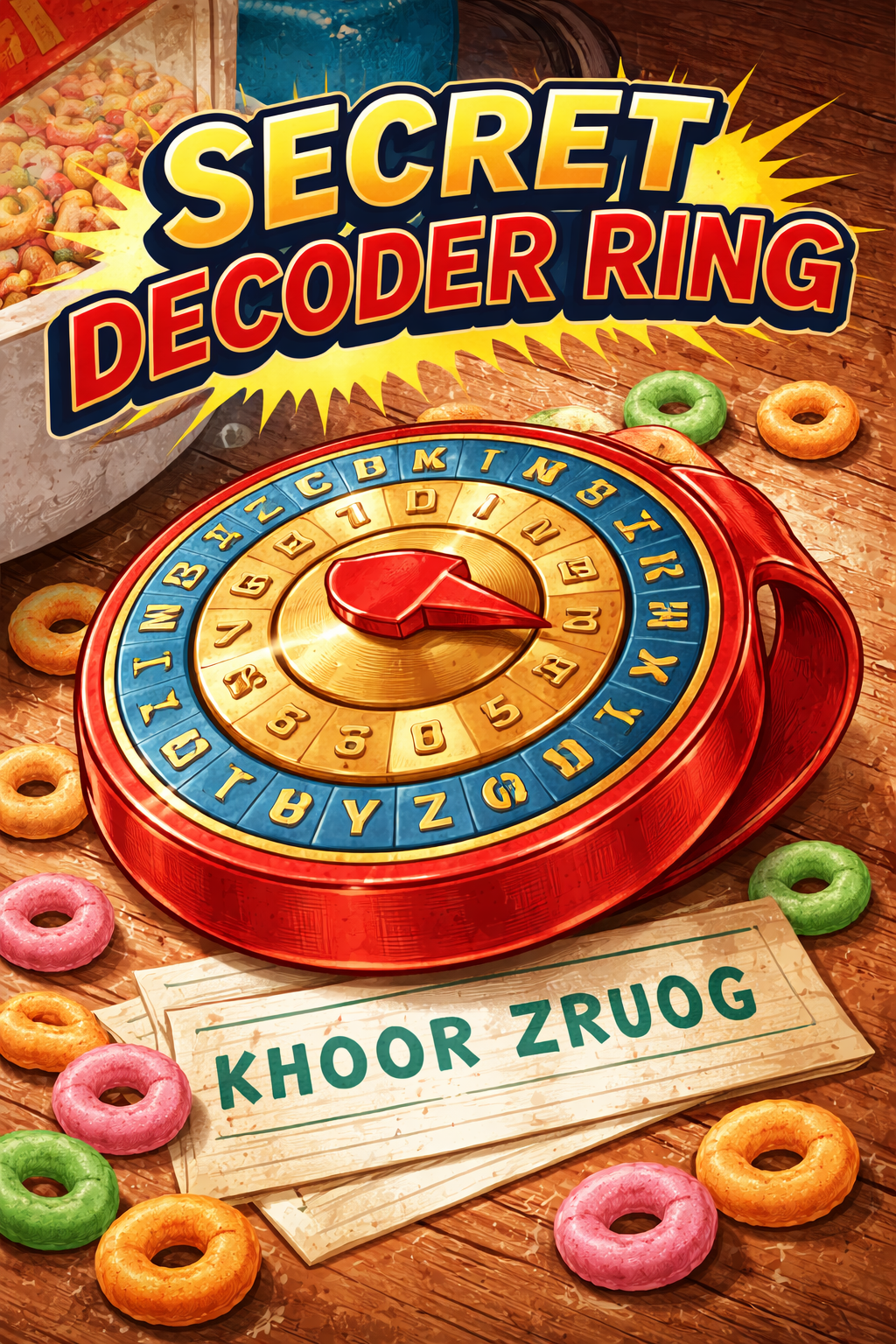
Do you remember decoder rings?
The kind that came in cereal boxes had two concentric rings of letters. You'd spin them against each other until they lined up correctly, then somebody could hand you a coded message like KHOOR ZRUOG and the meaning would appear one letter at a time.
Hello world.
The message wasn't really the interesting part. The alignment was. Change the relationship between the rings and the same symbols produce something different.
Pattern Grammar starts with a similar idea, then does something a decoder ring can't do.
Instead of encoding a story so that somebody else can recover it exactly, we deliberately throw information away. Characters disappear. Setting disappears. Plot details disappear. Particular images and phrases disappear. What remains is a small collection of relationships and movements that we've chosen to preserve.
Then we hand that remainder to an AI and ask it to make something new.
You don't get the original story back.
That's the game.
How it works
Start by writing a story. Any story works, although short ones make the experiment easier to see. It can be a myth, memory, fragment, dream, character sketch or something that doesn't fit neatly into any of those categories. It just needs enough movement that something changes between the beginning and the end.
Then compress it into what I'm calling a Pattern Grammar.
You're not summarizing the story. You're deciding what relationships matter enough to survive when most of the story is removed. Perhaps something begins closed, encounters pressure, resists, loses something, opens and returns differently. Perhaps the important movement is approach, recognition, withdrawal and incomplete return. The particular nouns don't matter yet.
This is where I'd describe the process differently than I did when I first developed it. I used to say we were stripping away the surface until we found the pattern underneath, as though the story contained one privileged hidden structure waiting to be discovered.
I'm not sure that's what we're doing.
Two people can compress the same story differently because they notice different relationships in it. One may preserve the emotional movement while another preserves the sequence of decisions. Another may notice a pattern of distance and return that neither of the first two considered important.
The compression is already an interpretation.
That's useful, because now we have more than one place for the experiment to move.
Once you have the Pattern Grammar, post it somewhere people can find it. Social media works. Forums work. Send it to friends. Don't include the original story yet.
Just give them the grammar.
Then have people feed it to different AI models and ask each model to generate a story from it. ChatGPT, Claude, Gemini, Grok, Mistral or whatever else somebody wants to try. Run it more than once through the same model too.
Share what comes back.
Now we get to see what survived.
What are we actually seeing?
The generated stories won't be copies. Characters, settings, imagery, pacing and even genre can change dramatically. A pattern extracted from a quiet story about two people might return as science fiction, mythology, rural realism or something nobody expected.
Some properties may recur anyway.
If the grammar specifies an opening state, a disruption, a costly turn and a changed return, we can look for those relationships in each generated story. Some models may preserve them closely. Others may preserve one relationship while quietly changing another.
That doesn't prove we've uncovered the original story's true underlying structure. It tells us something more concrete:
We selected a set of properties to preserve, and now we can watch what survives repeated transformation.
That gives us several things to compare at once: the original story, the human-produced compr