
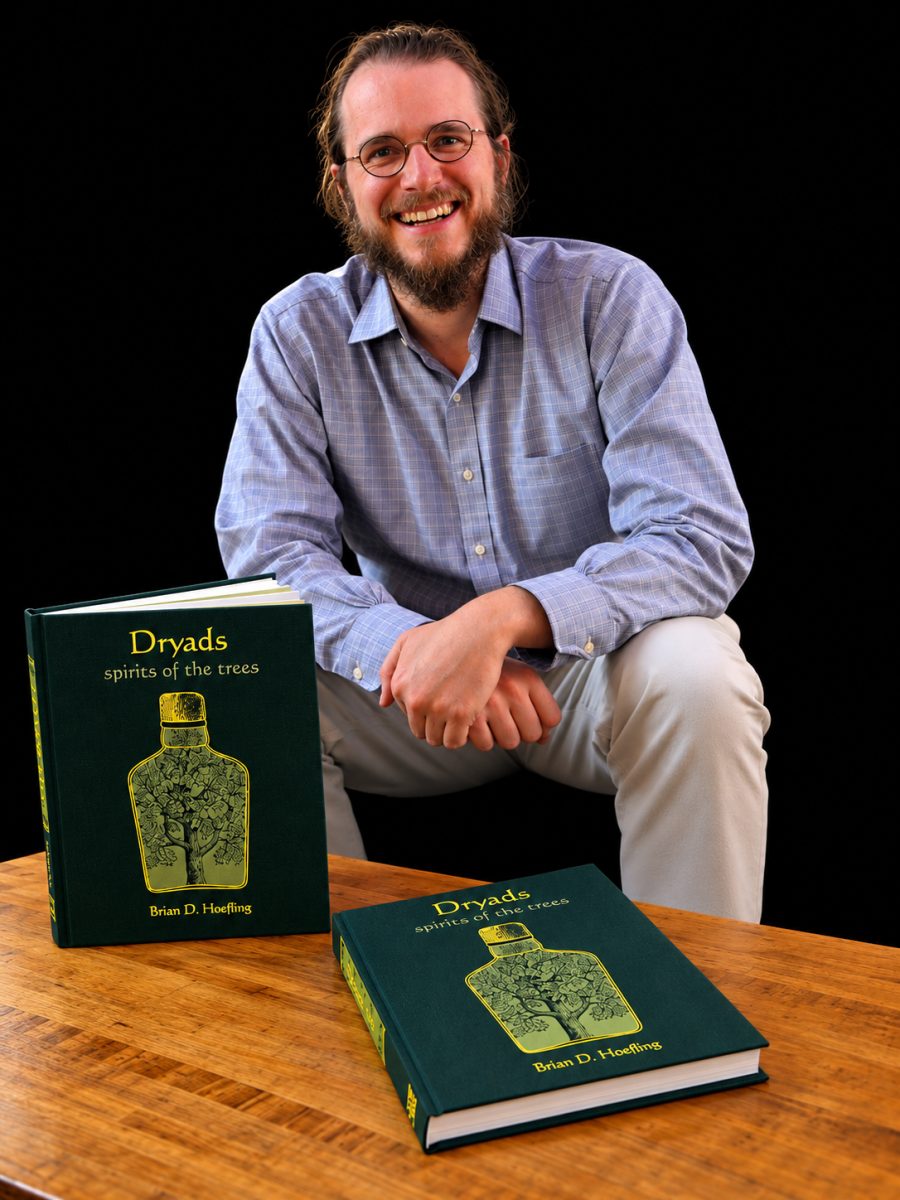
ARKVILLE — Brian D. Hoefling has written a book about his search around the world for Dryads. A Dryad is a spirit that lives in a tree. Now, the skeptic among us, reading this will say, tisk, tisk, tisk, what stuff and nonsense. But, be assured that skeptic has never had the ultimate joy of tasting a "Union and Liberty," a cocktail served at Arkville’s Union Grove distillery, made with, of all things, a maple spirit. Brian Mulder has discovered the dryad that lives in maple trees and freed it, only to trap it in a bottle to prove to you that there are spirits in trees. And good spirits they are! Move over Tinkerbell.
Brian Hoefling is my kind of writer. He has a great background in booze, and a great spirit of alcohol adventure, not the kind that introduces you to the local constabulary, late at night, staring into the beam of a large flashlight, but the kind where you are in a place you have never been and your new friends bring out the local libation. As Brian puts it, "In most bars, certainly in this country, and much of the world, you try and survey what bottles they have," You ask, "What were the sugars and starches that made this alcohol? It is a list of about 10 species that each of us can probably list sitting here."
But how many of us have gone to Sri Lanka, because you have heard of a palm sap spirit, Ceylon Arrack. But hearing that they ferment the sap of unopened coconut palm flowers, the few adventurers in the world of alcohol spirits, pack their rucksacks and head to the airport. In my youth in Ireland, the alcohol spirits that most of us knew of were poteen, the illegal whiskeys of Ireland and the clúrachán, who enslaved you and made you drink poteen. But, Brian came to find the world is full of wood saps that contain spirits waiting to capture and amaze us.
In 2023, Brian was putting together a panel for a hospitality conference and realized he could build the panel around spirits found in trees. He had a Sri Lankan Arrack producer; a Nigerian Raffia Palm spirit (Ògógóró) producer; and a sugar maple producer from Quebec. As he put the panel together he learned of more tree sap based spirits. By the time the panel was over, he had decided it was to be the subject of his next book.
Brian has dived deep into the history of tree spirits. The earliest reference he has found to a distillate of maple sugar is a letter from Thomas Jefferson to George Washington on the subject of a maple spirit here in New York. "When Jefferson was Secretary of State," Brian tells me, "he toured New York State encouraging people to tap their maple trees rather than cutting them down... He met a guy named Arthur Noble, [he] provided Jefferson with a sample of a spirit made from maple sugar that was very much like whiskey."
According to Brian, the "United States is the only country in the world that has two biological families represented. We have one palm sugar distiller in California". He speaks of the many tappable trees. "We have tons of birches." Brian knows several distillers who have considered making spirits from birch sap. Brian is aware of four distillers in Europe that have produced birch spirits, Sweden, Russia and two in the UK. Two of the distilleries that produced birch spirits have closed. There are other sugar yielding trees in North America that some people tap for non-commercial distillation, Brian has found, but, as their sugar yields are low compared to the Maple and Birch trees, trees such as Black Walnut, Beech, Bass and Sycamore are likely not commercially viable. "Hickory sugar exists" but hickory is usually used as a flavoring, rather than the source of the spirits.
Brian, in the last chapter of his book, speaks of how there are new methods used in Maple Sugar extraction which may widen the variety of dyad spirits in the future. I nod as if I know what he is talking about as he speaks of using "reverse osmosis" to extract water and condense the sugar output. Thank God I can look it up and explain it in the