The Mountain Eagle has been publishing in the Catskill Mountain region for generations. For most of that history, the product was easy to recognize: reporters gathered information, the newspaper printed it, and copies moved through the region once a week.
That still happens, but everything that has to exist around the newspaper has changed.
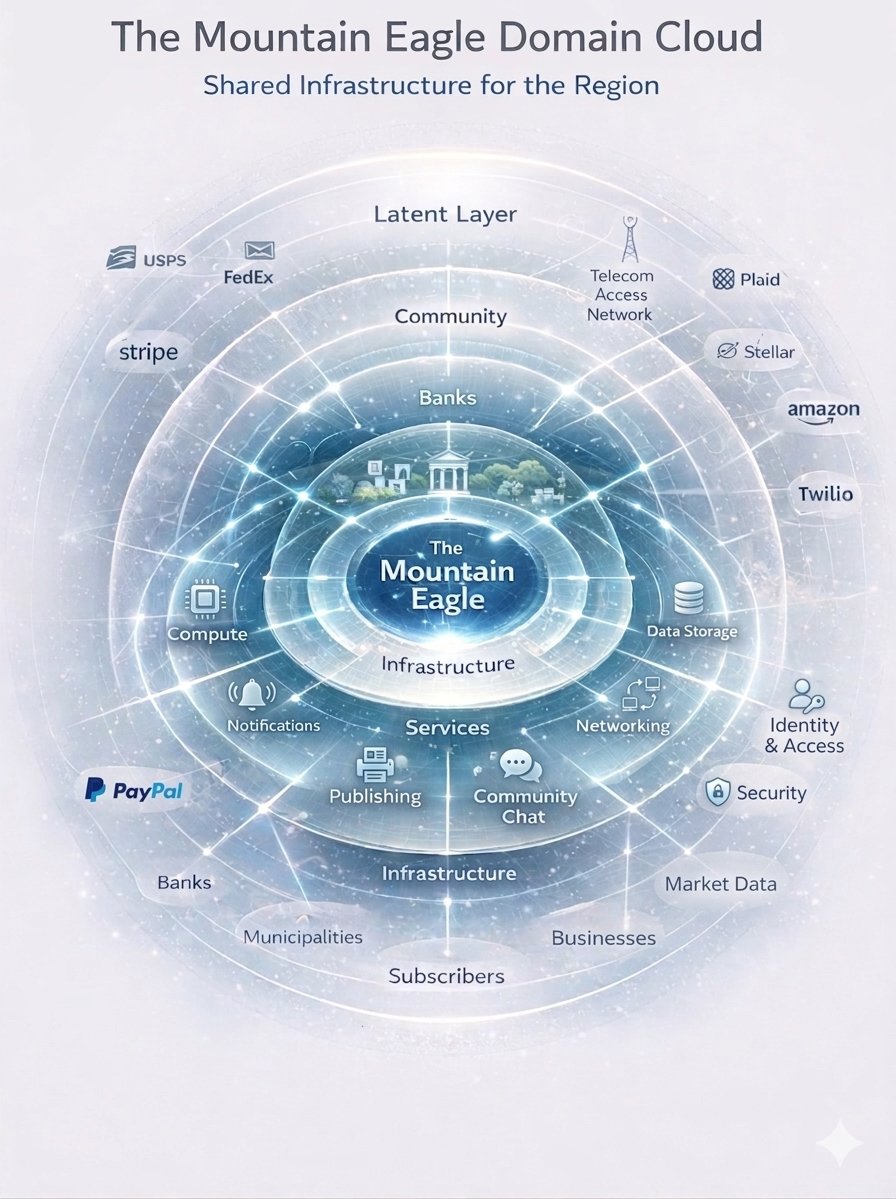
A modern local newspaper needs publishing systems, subscriptions, payments, archives, advertising workflows, email, messaging, analytics, delivery tools, security, backups and relationships with outside services. Once those pieces began accumulating around The Mountain Eagle, they stopped looking like separate tools supporting a newspaper and started looking like shared infrastructure capable of supporting other relationships in the region.
We call that infrastructure the Domain Cloud.
The name can be misleading if “cloud” brings to mind a distant data center owned by a large technology company. In this case, the important boundary is almost the opposite. The Domain Cloud is locally operated infrastructure that can use outside services where they make sense without requiring those services to become the place where the community itself is represented.
The newspaper is the seed. The Domain Cloud is what has grown around it.
Why build any of this?
Rural communities have encountered versions of this problem before. Electricity, telephone service and other expensive infrastructure often reached dense markets first because those were the places where conventional economics made deployment easiest. Cooperative and locally organized models gave smaller communities another way to assemble capabilities that individual households and businesses couldn't reasonably build alone.
Digital infrastructure is different from an electrical grid, so the analogy only goes so far. Most of the technology already reaches rural communities. We can use global payment processors, social networks, cloud storage, email providers and publishing platforms from almost anywhere.
The modern problem is less about access to technology than about where relationships live once we use it.
A business may have one identity in the newspaper, another on Facebook, another in a payment processor and another in a marketplace. Events disappear into social feeds. Articles become detached from the organizations and places they describe. Subscriber information lives in one system, advertising in another, delivery records somewhere else, while years of community history remain trapped inside individual newspaper pages.
The Domain Cloud grew from trying to connect those things without requiring one outside platform to own the relationships among them. That distinction matters more to me now than whether every component is locally built.
Start with the newspaper
The Mountain Eagle still publishes a weekly print newspaper alongside continuous digital publishing. Those aren't competing products. They operate at different speeds and serve different uses.
Print gives the week a durable form. Digital can publish something when it happens, update it as more becomes known, connect it to an event or organization, and make it available to someone hundreds of miles away. An article can later move into print, while something that begins in print can point through a QR code toward a changing digital object.
The important part isn't simply that both formats exist. It's that they can participate in the same history.
An event announcement can become a structured calendar entry. Later reporting can remain connected to the event. An organization mentioned repeatedly over several years can maintain a current profile while old reporting remains available in the archive. A business advertisement can point toward a persistent digital presence rather than disappearing when the newspaper is recycled.
The newspaper becomes one projection of a larger relationship graph. That graph isn't the community itself. It's a partial representation of relations