
CATSKILLS REGION — A recent Associated Press story about layoffs at McClatchy newspapers caught my attention.
More than 90 unionized journalists and media workers were laid off across 17 publications, including the Miami Herald, Sacramento Bee, Kansas City Star and Charlotte Observer. The cuts eliminated reporters covering local government and investigations in several communities.
There are plenty of reasons to care about those losses. Fewer reporters usually means fewer people attending meetings, asking questions, following stories over time and noticing things that might otherwise go unnoticed.
Something else in the story caught my attention. McClatchy executive vice president of local news Greg Farmer wrote that the company had maintained its investment in local reporters for five years because it believed stronger journalism would strengthen its relationship with subscribers and its business.
“We measured the results,” Farmer wrote.
McClatchy concluded that subscriber interest didn’t support continuing that level of investment. This is a company large enough to spread technology, management and other costs across newspapers around the country. It has economies of scale that a locally owned newspaper serving a few rural counties will never have, and it still didn’t produce the result they expected.
That suggests the problem may be somewhere else.
Forty years ago, a local newspaper wasn’t only a collection of news articles. It carried birth and wedding announcements, obituaries, photographs, legal notices, classifieds, jobs, real estate, community events, business advertising, school news, sports and letters from readers. People opened the newspaper for different reasons and encountered one another along the way.
The Internet didn’t simply give newspapers a cheaper way to publish articles. It separated many of those relationships. Jobs went to employment sites. Real estate moved to specialized platforms. Businesses created websites and social media accounts. Governments began publishing directly. Events moved onto social networks and online calendars.
Newspapers lost more than advertising revenue. They lost many of the ordinary ways people interacted with them and with one another through them. Many responded by concentrating more heavily on journalism.
Journalism matters. We wouldn’t operate a newspaper if we thought otherwise. The question is whether journalism was ever supposed to carry the newspaper by itself.
At The Mountain Eagle, we’re increasingly convinced that it wasn’t, and that realization has changed what we’re building.
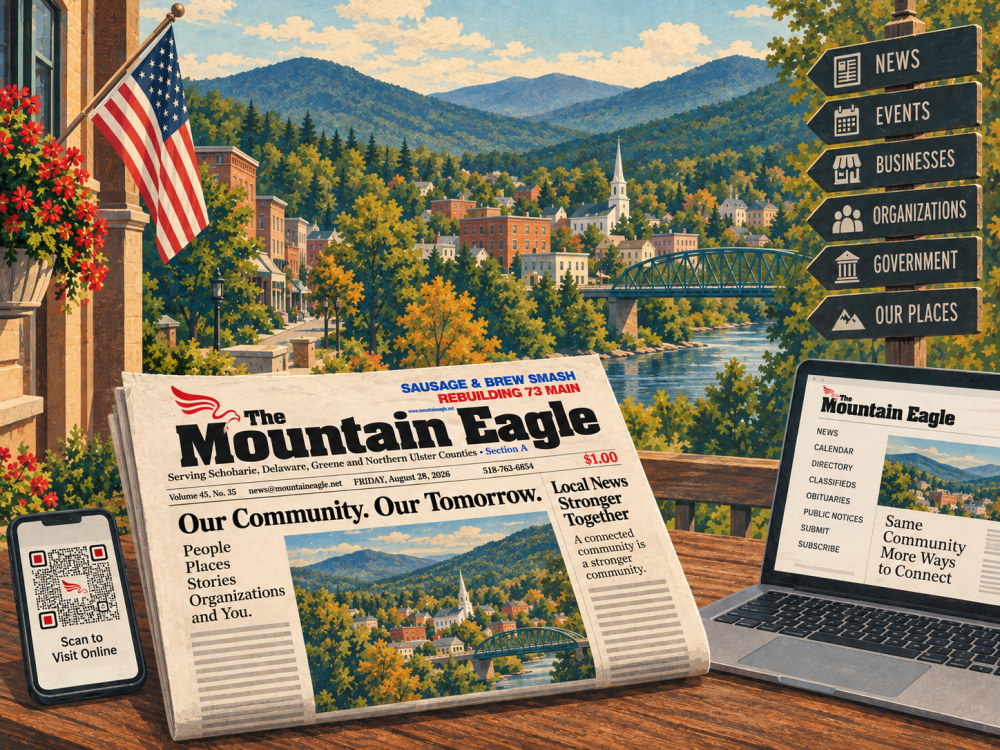
Our website isn’t simply a digital copy of the printed newspaper. Businesses and organizations can maintain profiles. Events can enter a community calendar. Members can submit articles, photographs and announcements for editorial review. Classifieds and press releases can be submitted directly. Radio reaches people who aren’t reading an article. Print sends readers online for additional information, while things discovered online can find their way into print.
None of this replaces journalism. It gives journalism a healthier place to live, and the same thinking is changing how we pay for it.
One-off advertising remains useful when someone has something specific to say. Our Benefactor Sponsorship Program creates a longer relationship, with businesses and organizations supporting the operation of the newspaper in exchange for an ongoing presence throughout the year. As we described in From Advertising to Presence, a local business doesn’t disappear when its advertisement does.
Subscriptions support journalism. Subscription growth not only increases our capacity for reporting, but also provides a useful feedback mechanism about where reporting is most needed.
Affiliates add another relationship. Local businesses and organizations can help us reach new subscribers and share in the revenue when they do. Instead of treating another local organization only as a potential advertiser, we