
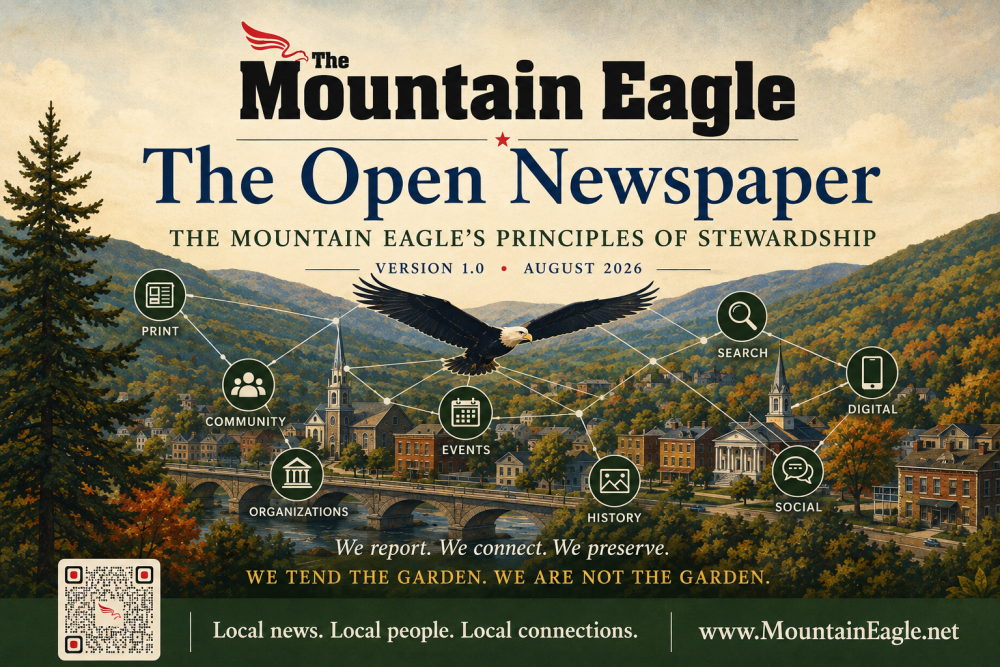
THE CATSKILLS - For over a century, newspapers have helped communities understand themselves. We report on what happened and announce what is coming. We introduce neighbors to one another and document births and deaths, businesses and governments, celebrations and conflicts.
Edition by edition, we create a record of ordinary community life that becomes more valuable as the years accumulate.
The tools available to newspapers such as ours are changing rapidly. Print now exists alongside instant access to the internet and people increasingly expect information to be immediately searchable and shareable from wherever they happen to be.
We adapt, but adaptation doesn't require abandoning the value we provided to the community in the first place.
Over the past several years, The Mountain Eagle has been experimenting with what a newspaper might become when print, digital publishing and community participation are treated not as competing products, but as parts of one connected local information system. We've built and discarded things. We've made mistakes -- so many mistakes! We've encountered boundaries that we didn't anticipate. Gradually, a set of principles has emerged from trial and error.
We call the idea behind them the Open Newspaper.
What do we mean by "open"? Open doesn't mean that everything gets published and it also doesn't mean abandoning editors, professional journalism, privacy, copyright, or editorial standards. It doesn't mean that everyone must create an account or participate digitally.
It means something much simpler.
An Open Newspaper should create as few unnecessary barriers as practical between people and useful community information. Readers should be able to read without obligational paywalls. People should be able to contribute information without needing to know someone in the newsroom. Organizations should be able to participate in maintaining their own public identities.
Print and digital publishing should connect instead of compete. Search engines and social networks should help information travel without becoming the owners of the community's memory. Technology should serve the relationships that already keep a community alive.
These are the principles currently guiding that experiment.
Value Is Relational
A newspaper's value lies in keeping the community connected. Digital technology can further bridge this gap, creating and fostering relationships between people and businesses.
Serve Where the Relationship Is Real
The internet makes it possible to claim an enormous geographic reach. That does not mean we should. Our service area should reflect communities we can meaningfully cover, understand and support.
Reduce Friction, Not Responsibility
People should be able to access newspaper services without unnecessary obstacles. Technology should make participation easier, though easier does not mean automatic. Submitted articles still receive editorial review, organizations must still authorize people acting on their behalf, and advertising remains distinct from journalism.
Preserve Appropriate Boundaries
A business or Benefactor advertising with us will not control our coverage of them. A contributor can submit information, but only we possess the authority to publish it. A social network can distribute our reporting without becoming its permanent home. These boundaries create trusting relatonships.
Represent Reality Before Participation
Our goal is to build an accurate representation of the communities we serve, including businesses and organizations that have never participated in our digital platform. Representatives may claim and maintain their existing directory profiles. The map should reflect the territory, not just the people who signed up for the map.
Identity Should Have a Purpose
Someone can buy a newspaper at a newsstand without being obligated to subscribe. They can also visit our website without becoming a member. Identity becomes necessary only when someone asks us to m