
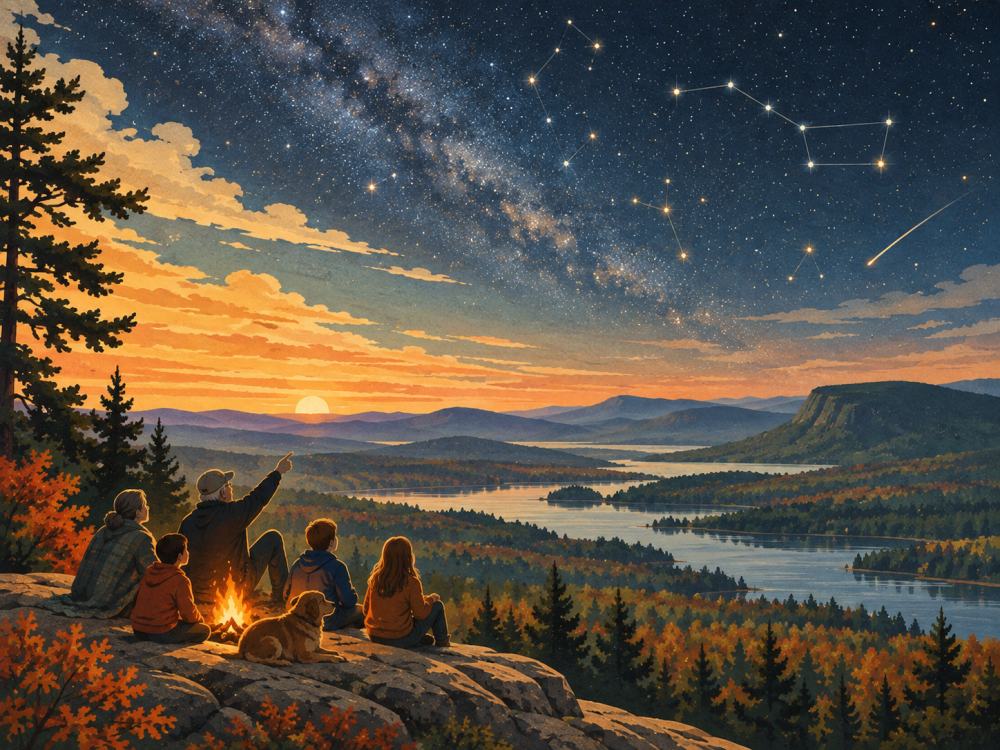
Before writing, before carved symbols, before anything we could easily carry unchanged across generations, we looked up.
We certainly weren't the first creatures to notice the sky, and our ancestors didn't look upward for only one reason. The heavens could help mark seasons, orient travel, anticipate recurring changes and provide material for stories about gods, ancestors, animals, danger, birth and death. Different peoples looked at the same stars and made very different things from them.
One property of the sky made all of those uses possible: much of it returned.
A river could change course. A forest could burn. A person who knew an old story could die. The night sky changed too, but many of its changes repeated in ways that extended beyond a single life. Stars returned with seasons. The Moon moved through recognizable phases. Certain lights wandered while others appeared to hold their relationships for longer than anyone watching them could remember.
That gave memory something outside itself to return to.
A page that wasn't really a page
It's tempting to call the sky our first page and the constellations our first symbols. I still like the image, although the analogy can mislead if we push it too far.
A written page preserves marks. The sky doesn't preserve the stories we attach to it. Orion doesn't contain Orion, and the stars of Ursa Major don't know that anyone connected them into a bear, a wagon or anything else. The physical arrangement provides a recurring reference while people supply the relationships that make it meaningful.
That may actually be more interesting than calling the sky a page.
A page carries its marks with it. The sky required each generation to reconstruct the connection.
Someone had to point upward and tell the story again.
That repetition created room for both continuity and change. A story could survive because recognizable features of the sky provided something to organize it around, while the telling could adapt to language, circumstance, audience and whatever else changed between one generation and the next.
The reference could persist while the meaning moved.
Memory with something outside itself
Human memory is reconstructive. We don't retrieve a perfect recording of an event each time we remember it, and oral transmission adds another layer of reconstruction as one person learns from another. Details can disappear, emphasis can shift, explanations can change, and later circumstances can alter what an old story seems to mean.
A recurring external reference doesn't prevent any of that.
What it can provide is constraint.
If a story is associated with a particular group of stars, the stars give future tellers something recognizable to point toward. If a ritual occurs during a recurring season, the season helps determine when the ritual returns. If travel depends on celestial observations, practical consequences provide another source of correction when memory and observation diverge.
The sky doesn't restore the original story when a line falters.
It gives the story somewhere to return.
That distinction matters because it lets us understand continuity without requiring exact repetition. The story can change while remaining connected to something that changes differently.
What stability makes visible
This relationship between a changing story and a slower-changing reference appears in many other places.
We use standard weights to compare measurements made by different people. We preserve documents so later events can be compared with earlier claims. A photograph gives memory an external object that can contradict some details while still requiring interpretation. A newspaper archive lets us compare what people said a project would become with what eventually happened.
None of these references is neutral or complete. A photograph has a frame. A document was written by someone. An archive contains what was recorded and omits what wasn't.
Their value comes partly from changin