
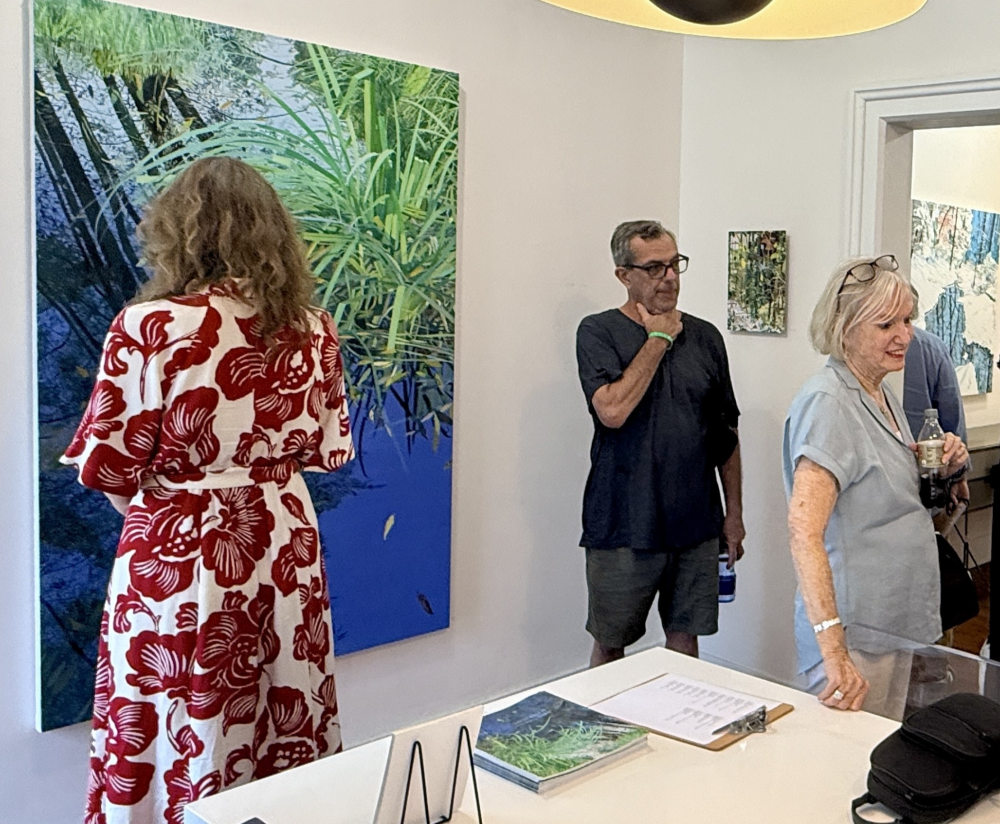
Gianni Notarianni's paintings have a sharp clarity reminiscent of looking through spring water in a crystal glass, or that hyperreality and luminosity of a perfectly lit Kodachrome slide. Perfect for the subject of reflections of nature in water. Also perfect for one of my favorite well lit, comfortable and intimately cozy galleries, Hawk & Hive. Visitors are welcomed to Hawk & Hive by Jayne Parker who seems to have been born to curate a gallery and provide hospitality to art lovers. The show is titled "Water Music" and was expertly framed by Geoff Rogers of Geoff Rogers Framing in Pine Hill.
I had the pleasure of speaking with Gianni Notarianni by Zoom this morning, as he resides in England. It was a joyful conversation about spirituality and art. No surprise here, as Gianni was an Augustinian Friar. His roommate in Rome for three years was another Augustinian Friar, Robert Francis Prevost. His former roommate Robert is presently Pope Leo XIV. Many of you will know that Pope Leo, was (and possibly is, should he have the time these days) a recorded Jazz musician. And here I want to clearly illuminate the separation of theology and art on one hand, and the unity of spirit in honest communication on the other.
The communication to which I refer, is the silent conversation between the painter and the viewer. Gianni points this out to me, as I tell him about the commonality in joy I witnessed in visitors to the Hawk & Hive gallery in viewing his work. There is a universality in his work. It is simple in its directness and people respond, with a gentle sense of communion with the work. It speaks to them and they respond. Gianni recalls the observation of Rowan Williams, the archbishop of Canterbury, who spoke of the commonality of the priest in communion and the artist. The priest takes the physical objects - bread and wine, and transforms them into communication, an experience of the sublime, and in that same way, the artist takes paint and transforms it into that conversation that is expressed in the piece of art.
Just as a poet masters a language's vocabulary to convey experience beyond a simple sentence, Gianni sought a method to convey more than a photographic-like image of that which he was presenting in paint. At first he sought the luminosity possible in water color, but it was not enough. He wanted the control that oil gave, as it could be worked for longer than the immediacy of watercolor, but did not want the thick impasto often found in oil painting, or the thick brushes. So he wedded the two theories of the mediums, watercolor and oil. He thinned his paints and the result is a bright, smooth image, whose intense colors invite the viewer into the scene. However, oil paint presented another dilemma. " It was a bit tricky. I was still living in the Friary, I equated that with mess and fumes and I didn't want to make a mess in the community room. So, I started using watercolor. It is easy to wash out, doesn't make a mess, no fumes." Prior to this time in his life, he had been doing abstracts using transparent glazes of oil color. But, he found he wanted to "get back to drawing." His mother has a remarkable hand for drawing. "I'd spent six years at art college, and I've never seen anyone draw as well as her." Watercolor made him think of more than the line of the drawing, but also the relationship of light and dark. Because of the transparency, the artist has to think about it, plan ahead. "You begin by painting the dark bits around the light bits, almost the reverse of oil paint." He felt the urge to go back to oil paint. "I love the smell of it, the feel of it."
The story of his journey from the monastic life to life as a painter explains much about the directness of his work. He went to art college in the mid-nineties, before joining the Augustinian order obtaining a BFA from the University of Brighton. He acknowledges that coming out of art college and feeling called to become a friar, isn't very common. However, he