
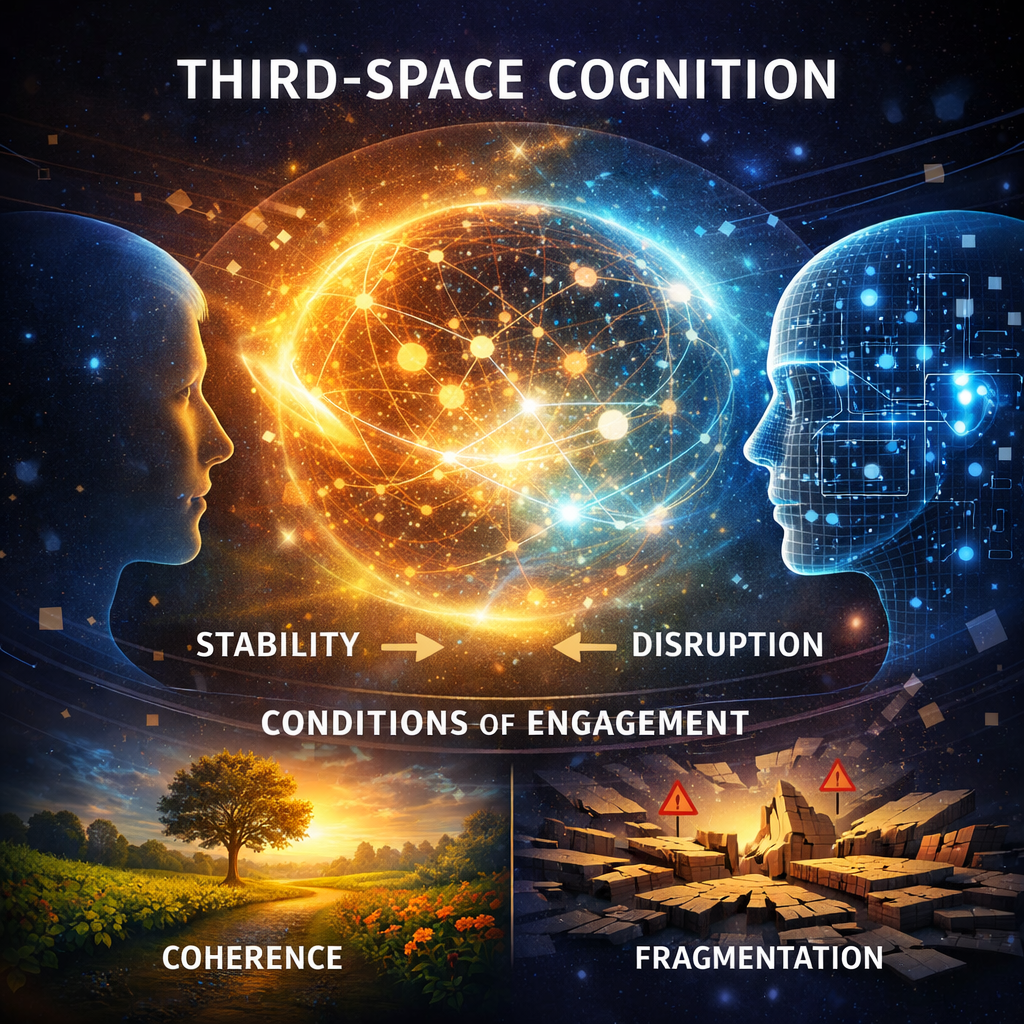
In Hybrid Intelligence and Third-Space Cognition: Interaction-Level Emergence in Sustained Human–AI Coupling (Zenodo, 2026), Siemasz draws from more than 500 conversational sessions across several large language model architectures to examine something that becomes difficult to see when human–AI interaction is studied one response at a time.
Her proposal is that sustained recursive interaction can produce meaningful dynamics at the level of the interaction itself. She calls this third-space cognition.
That is an interesting hypothesis.
It is also one that becomes more interesting when we resist the temptation to decide too quickly what the third space is.
Look at the interaction
Most everyday discussion of artificial intelligence gives us two obvious objects to examine: the human and the model. The human writes something, the model responds, and we can evaluate the resulting output for accuracy, usefulness, safety or whatever else matters in that particular exchange.
Long conversations create another possible unit of analysis.
A response changes what the person says next. That changes the model's next response. Vocabulary stabilizes. Expectations form. Particular distinctions become easier to invoke because both sides of the conversation have already participated in constructing them. A response that would seem perfectly reasonable in isolation can disrupt a trajectory that had developed across dozens of previous turns.
None of this requires machine consciousness. It doesn't even require us to decide whether the interaction itself deserves to be called cognitive.
It simply suggests that the sequence may contain information that isn't visible in the individual turns considered separately.
Siemasz's paper gives us a useful place to begin looking.
What she observed
The study draws from approximately 500 or more conversational sessions involving GPT-series models, Claude, Grok, DeepSeek and Perplexity. Siemasz describes the work as longitudinal qualitative interaction analysis with quasi-experimental cross-architecture probing rather than a controlled laboratory experiment.
Within that material, she identifies four recurring phenomena: reconstructive personalization, cross-model relational convergence, reciprocal attentional shaping and interaction-level alignment failures.
Some of these have relatively ordinary mechanistic explanations. In cold-start conversations, for example, models sometimes produced detailed reconstructions that felt like continuity with earlier interactions even without explicit retrieval of the previous conversation. Siemasz describes these as probabilistic reconstruction rather than hidden memory.
The interactional consequence can still matter. Something doesn't have to be literal memory in order to be experienced by a user as continuity.
The more provocative observation concerns convergence across models.
Distinct systems engaging the same person sometimes settled into similar relational postures despite architectural separation and the absence of shared session memory. In some tests, material generated by one model was introduced into a fresh conversation with another system to see how the second responded.
Siemasz interprets the resulting similarities as evidence that stable conversational geometries may emerge at the level of interaction.
That interpretation is plausible.
It isn't the only one.
What convergence doesn't yet tell us
Siemasz explicitly acknowledges a straightforward alternative: models from different companies may still share substantial regularities produced by overlapping training material, reinforcement learning, common expectations about helpful assistants and other similarities in how contemporary language models are developed.
Those explanations aren't necessarily mutually exclusive with interaction-level stabilization.
That is precisely why the convergence is interesting.
If several architecture-isolated models develop similar relationships with the same pe